The next generation of MySQL DBA exams are going to be performance based tests (PBT) or 'Hands on'. A candidate will have a series of tasks to be performed, a virtual server, and a time limit. The tasks are going to be based on the usual tasks performed by a Database Administrator. For instance, a candidate will get a list of user accounts that need to be added, updated, or deleted and will be graded on how well they meet the objectives.
I have already asked my fellow MySQL employees to review the tasks but I would like to have some input from the public. Following the Open Source dictum of the more eyeballs looking at a problem will provide better products, I would like to get some of you to look at the proposed tasks and give me your comments.
In the past there have been complaints on questions being too syntax specific, too picky, and asking for too obscure knowledge. This is a chance to help make sure that the exam covers the scope of the DBA jobs.
You will get a chance to review the proposed tasks and evaluate them. What I need is to find out if the task is something that a very good DBA would be able to do as part of their regular duties. You will get a few days to look at the tasks and get your feedback to me.
So if you have some spare time and want to help develop the next generation of MySQL DBA exams, please send an email with the Subject of 'VOLDBA' (yup, uppercase to catch a filter) to dstokes AT mysql.com.
So are the 5.0 exams going away? Not anytime soon. The lead time for the new exams, with new technology, and new questions is going to be pretty long. Last month the numbers of test takers was up 33% over the previous month.
And I keep getting emails from hiring managers and recruiters looking for Certified MySQL professionals. MySQL is getting more popular everyday and their is a vacuum in the talent pool. Heck, look at the MySQL Job Forum at some of the interesting positions out there.
I used to work for an online recruiting company and can go into very boring detail on how recruiters looks for keywords. Even a top notch technical recruiter may not know Ajax from Ruby but they will catch the words certified or certification.
So hit the Certification Study guides, get that Cert, and find that dream job!
Monday, July 7, 2008


Monday, June 30, 2008
North Texas Meetup 7/7 at 7PM
Please join us at the North Texas MySQL Meetup if you are in the Dallas area this coming Monday July 7th, at 7PM. This is our first time at the Sun Office (Mansions 1 and 2 rooms of the Sun Office, 16000 Dallas Parkway, Ste 700, Dallas, TX Dallas, TX 75248). We have been a good little group but now we need more room to hold more bodies. And the location should be better for those in Dallas.
There will be a short presentation on Getting Started with MySQL and Studying for the Certified MySQL Associate Certification and will be followed with a general 'round table' discussion.
Anyone interested in MySQL is welcome but please RSVP at http://mysql.meetup.com/250/
And the next night is the DallasPHP.org meeting -- a great resource for all levels of PHP coders. A blub from their website The Dallas area has many highly experienced PHP developers, and is adding new developers all the time. This July, the greybeards of DallasPHP are going to cover the PHP basics, talking you through the fundamentals of PHP, its history, and pointing out some of the obscure artifacts still lingering around in the language. If you're new to PHP or just want to talk about how it came to be what it is, join us this month.
Maybe we can chip in and buy those 'graybears' some of the Just For Men hair coloring for facial hair.
There will be a short presentation on Getting Started with MySQL and Studying for the Certified MySQL Associate Certification and will be followed with a general 'round table' discussion.
Anyone interested in MySQL is welcome but please RSVP at http://mysql.meetup.com/250/
And the next night is the DallasPHP.org meeting -- a great resource for all levels of PHP coders. A blub from their website The Dallas area has many highly experienced PHP developers, and is adding new developers all the time. This July, the greybeards of DallasPHP are going to cover the PHP basics, talking you through the fundamentals of PHP, its history, and pointing out some of the obscure artifacts still lingering around in the language. If you're new to PHP or just want to talk about how it came to be what it is, join us this month.
Maybe we can chip in and buy those 'graybears' some of the Just For Men hair coloring for facial hair.
Thursday, June 26, 2008
New Cluster Certification Study Guide
The second edition of the
MySQL 5.1 Cluster Study Guide is now available through Vervante books.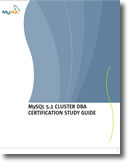 Those of you who have patiently emailing me to ask when you can order your copy should should get their order in ASAP.
MySQL 5.1 Cluster Study Guide is now available through Vervante books.
Those of you who have patiently emailing me to ask when you can order your copy should should get their order in ASAP.
Wednesday, June 25, 2008
Cluster Study Guide
A new edition of the MySQL 5.1 Cluster Certification Study Guide is due out any day now. As soon as I get the new on the availability, you will see it here. It will be bigger, better, and all the marking adjectives you would ever want.
But the original, first printing is sold out.
But the original, first printing is sold out.
Monday, June 23, 2008
Example MySQL Certification Exam Questions
Over the weekend I received a few emails asking for sample questions for the four MySQL Certification exams. There is a CDROM that comes with the MySQL 5.0 Certification Study Guide that covers the Developer and DBA Questions. The MySQL 5.1 Cluster Certification Study Guide (next edition due any day) has questions at the end of every chapter.
And there are questions that are just slightly modified from each ofthe four exams at http://www.mysql.com/certification/selftest/core/index.php
And there are questions that are just slightly modified from each ofthe four exams at http://www.mysql.com/certification/selftest/core/index.php
Tuesday, June 3, 2008
CLI Lives!
I got a fair amount of response from my last blogging about including the MySQL Administrator tool as a useful utility in a hands on exam for DBAs. In general I do not like GUIs and prefer the old fashion way. The first thing I did after getting my Mac laptop was open up a terminal to get to the command line interpreter. But I never expected so many to be in favor of forgoing the Administrator tool and sticking with the CLI.
You can read the comments for yourself. I found myself agreeing with all of them. I did receive some private emails that generally distilled to the DBA exam being test of DBA skills and not how well one can manage the latest version of an add-on product.
One of the reasons I used to tell novices to use the vi editor was that it was a common denominator and would be there at three in the morning after your data center had go to heck and you needed to get your servers back on line.
And so, you will get to do the next generation of exams on the CLI.
You can read the comments for yourself. I found myself agreeing with all of them. I did receive some private emails that generally distilled to the DBA exam being test of DBA skills and not how well one can manage the latest version of an add-on product.
One of the reasons I used to tell novices to use the vi editor was that it was a common denominator and would be there at three in the morning after your data center had go to heck and you needed to get your servers back on line.
And so, you will get to do the next generation of exams on the CLI.
Friday, May 30, 2008
MySQL Administrator and Future Exams
Many vendors are going to performance based testing, also known as hands on exams. Most of the criticisms I receive on a regular basis that that all Certification Exams are PICKY or rely too much on the memorization of trivia. 'Besides, a real {DBA|Developer} never uses most of those commands in Real LifeTM!'
Well, your next MySQL Exam just may eschew most of those complaints. Developers could be asked to normalize tables, DBAs could be asked to set up replication, and Cluster DBAs could be asked to set up a full cluster. There are many details to be worked out.
One of these details are tools that do not come with your MySQL Server. I find the MySQL Administrator a very valuable tool for quick, day-to-day DBA tasks. I am probably not alone in using it. But would it be fair to allow it on a hands on exam? How about other tools?
So, if YOU have an opinion, please let me know and help guide the MySQL 6.0 Exam development.
Well, your next MySQL Exam just may eschew most of those complaints. Developers could be asked to normalize tables, DBAs could be asked to set up replication, and Cluster DBAs could be asked to set up a full cluster. There are many details to be worked out.
One of these details are tools that do not come with your MySQL Server. I find the MySQL Administrator a very valuable tool for quick, day-to-day DBA tasks. I am probably not alone in using it. But would it be fair to allow it on a hands on exam? How about other tools?
So, if YOU have an opinion, please let me know and help guide the MySQL 6.0 Exam development.
Friday, May 23, 2008
CMA Exam -- Transactions
The Certified MySQL Associate Exam is a general overview of the MySQL database. It is designed for those new to databases and/or MySQL.
The subject of transactions has caused a few folks to stumble on their exams. For someone with a background in programming where you change data and it stays that way, transactions take a little effort to understand.
The usual example is a payment at a bank. A pays B 100 units. If something happens between the time the system takes the 100 out of A's account and puts it into B's account, there is a large chance that both A and B will not be happy. So the subtract 100 and add 100 are treated as one unit and either both have to be completed as a unit or not at all.
So all or nothing.
You type START TRANSACTION, input the needed changes, and COMMIT. And your changes are done as one to your database. Or half way through you realize that something is wrong and use ROLLBACK to get back to where you were when you typed START TRANSACTION.
Almost.
First, you have to use a storage engine that supports transactions. Try using START TRANSACTION and COMMIT with MyISAM and see how it reacts.
Second, some commands like CREATE TABLE, DROP TABLE, or UNLOCK TABLES (see MySQL Reference Manual section 12.4.3) can cause MySQL to implicitly issue a COMMIT on your behalf. You have better know these to help you pass the exam and to keep your sanity on the job.
The subject of transactions has caused a few folks to stumble on their exams. For someone with a background in programming where you change data and it stays that way, transactions take a little effort to understand.
The usual example is a payment at a bank. A pays B 100 units. If something happens between the time the system takes the 100 out of A's account and puts it into B's account, there is a large chance that both A and B will not be happy. So the subtract 100 and add 100 are treated as one unit and either both have to be completed as a unit or not at all.
So all or nothing.
You type START TRANSACTION, input the needed changes, and COMMIT. And your changes are done as one to your database. Or half way through you realize that something is wrong and use ROLLBACK to get back to where you were when you typed START TRANSACTION.
Almost.
First, you have to use a storage engine that supports transactions. Try using START TRANSACTION and COMMIT with MyISAM and see how it reacts.
Second, some commands like CREATE TABLE, DROP TABLE, or UNLOCK TABLES (see MySQL Reference Manual section 12.4.3) can cause MySQL to implicitly issue a COMMIT on your behalf. You have better know these to help you pass the exam and to keep your sanity on the job.
Sunday, May 11, 2008
DBA Knowledge
Work on the next generation of MySQL Database Administrator Exams has started and it raises the question of 'What does a DBA actually do?
The vivacious Sheeri Kritzer Cabral had a list of Best Practices for Database Administrators that is a good starting point. A lot of the items she lists are hard to quantify, especially for someone who has to write performance reviews and make salary increase recommendations.
I used to work for a program manager who was very good at managing developers by the numbers of lines of code generated, bugs fixed, and number of hours spent in the little gray cubicles. DBA work is not as easy to quantify. It was frustrating for both of us as there was no discrete output to log, report and graph. And how can examining buffer cache hits rates be valued by an employer in comparison to someone putting new options on a web page.
There is not a little pile of widgets at the end of the day to count and then divide by the numbers of hours worked to prove productivity. So, let us look at the quality of the work instead of a quantity.
What should a very good DBA fresh off the street be able to do the first day of a new job? Or what are the things you should check on a new job.
So the next generation of exams are going to be less based on knowledge of syntax, options or keywords and more on actual job performance. New advances in testing technology will allow us to quantify skills with a MySQL database and add much more value to the MySQL Database Administrator Certification.
More on the new exams will be posted here when the news is available.
The vivacious Sheeri Kritzer Cabral had a list of Best Practices for Database Administrators that is a good starting point. A lot of the items she lists are hard to quantify, especially for someone who has to write performance reviews and make salary increase recommendations.
I used to work for a program manager who was very good at managing developers by the numbers of lines of code generated, bugs fixed, and number of hours spent in the little gray cubicles. DBA work is not as easy to quantify. It was frustrating for both of us as there was no discrete output to log, report and graph. And how can examining buffer cache hits rates be valued by an employer in comparison to someone putting new options on a web page.
There is not a little pile of widgets at the end of the day to count and then divide by the numbers of hours worked to prove productivity. So, let us look at the quality of the work instead of a quantity.
What should a very good DBA fresh off the street be able to do the first day of a new job? Or what are the things you should check on a new job.
- Check to make sure the root account has a password? Do all the accounts have passwords? Do the hosts exclusion or inclusion fit the current network?
- Are backups being made? Are they any good? IS everything being backed up?
- Is replication running?
- Is the server optimized?
- What versions of software are in use? How old is that?
So the next generation of exams are going to be less based on knowledge of syntax, options or keywords and more on actual job performance. New advances in testing technology will allow us to quantify skills with a MySQL database and add much more value to the MySQL Database Administrator Certification.
More on the new exams will be posted here when the news is available.
Sunday, May 4, 2008
Getting Started wit MySQL & North Texas MySQL
Saturday was the Dallas Tech Fest. Several hundred developers heard presentations on the latest and greatest from several vendors and speakers. Sun was was on the sponsors and I spent a few hours meeting and greeting.
Several people were interested in MySQL but had no idea where to start. MySQL's download page really needs a 'hey, first timers who want to learn MySQL, click here to get the server and GUI tools in one fell swoop'.
As one of the shrinking numbers of CLI-centric dinosaurs, I acknowledge that most of the world prefers point-and-click and the MySQL Administrator makes quick work of many statements that require fussy typing. The Query Browser is also one of those tools that quickly becomes a regular in your arsenal. Add in the Workbench and you have a pretty complete set of tools for designing, administrating, and using your databases.
Then you need a good book on MySQL. I will try to do a rapid review next entry.
--
If you are in the Dallas/Fort Worth Area, Monday night at 7:00pm will be a meeting of the North Texas Linux Users Group. We will have a quick presentation on getting started with MySQL on Unbuntu. Then we will discuss moving the meetings to someplace more Dallas-centric (or not) like the Sun Office off the Dallas Tollway. After the meeting, adults can go celebrate the day most of Americas thinks is Mexican Independence Day (it is really in September but 'Cinco De Mayo' is a little easier to pronounce for non-Spanish speakers than the 16th of September in Spanish).
Several people were interested in MySQL but had no idea where to start. MySQL's download page really needs a 'hey, first timers who want to learn MySQL, click here to get the server and GUI tools in one fell swoop'.
As one of the shrinking numbers of CLI-centric dinosaurs, I acknowledge that most of the world prefers point-and-click and the MySQL Administrator makes quick work of many statements that require fussy typing. The Query Browser is also one of those tools that quickly becomes a regular in your arsenal. Add in the Workbench and you have a pretty complete set of tools for designing, administrating, and using your databases.
Then you need a good book on MySQL. I will try to do a rapid review next entry.
--
If you are in the Dallas/Fort Worth Area, Monday night at 7:00pm will be a meeting of the North Texas Linux Users Group. We will have a quick presentation on getting started with MySQL on Unbuntu. Then we will discuss moving the meetings to someplace more Dallas-centric (or not) like the Sun Office off the Dallas Tollway. After the meeting, adults can go celebrate the day most of Americas thinks is Mexican Independence Day (it is really in September but 'Cinco De Mayo' is a little easier to pronounce for non-Spanish speakers than the 16th of September in Spanish).
Subscribe to:
Posts (Atom)